The project ends. The installation happens. The client walks through their finished home and has the moment Devon’s team works toward on every engagement: the space looks exactly the way it was supposed to look, and the client finally understands why all those decisions took as long as they did.
Then, a year later or two years later or when a vacation home comes into the picture, they call Duet again.
This isn’t a coincidence. It is the logical outcome of a design relationship built on something more durable than a single project.
What Repeat Clients Are Actually Buying
Working with an interior designer long term looks different from a series of disconnected transactions. The second project is easier than the first. The third is easier than the second. Not because the work becomes less careful, it doesn’t, but because a significant amount of the foundational work is already done.
Duet knows how the client thinks. They know which decisions the client will engage deeply with and which ones they’re happy to trust the team on. They know the client’s aesthetic instincts, where they’re consistent and where they occasionally surprise themselves. They know the existing homes, the established palette, and the pieces that carry meaning that should never be touched.
What That Continuity Saves
A new client engagement at Duet involves a substantial investment of time in the early discovery and style identification process. Not because it’s inefficient, but because it’s doing real work. It surfaces preferences the client couldn’t have articulated before the exercise. It resolves contradictions in what the client says they want versus what they actually respond to. It produces a design brief that is accurate rather than aspirational.
When a returning client begins a second project, that foundational work translates directly. The discovery process is compressed because the team already knows most of what it needs to know. The design brief for the new project is written in the context of everything Duet already understands about the client. Time that would otherwise go to orientation goes instead to design.
Houzz’s annual research on home improvement and design consistently finds that clients who have worked with a designer before report higher satisfaction with the process and the result than first-time design clients, even when the first-time clients are working with equally capable firms. The difference is the foundation. A returning client doesn’t start from zero. The project begins at a point that takes first-time clients months to reach.
The Multi-Property Reality
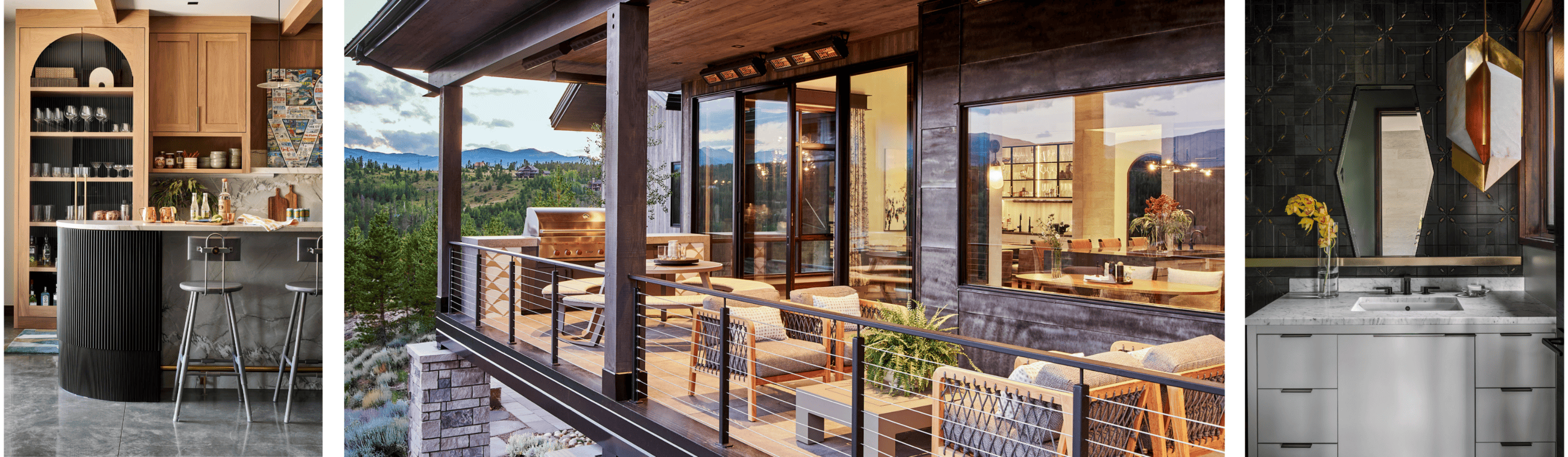
A significant portion of Duet’s repeat clients are managing more than one property. A primary residence in Cherry Hills Village or Boulder and a mountain home in Vail or Steamboat. A full-home redesign and, a few years later, a guest suite addition. A completed renovation that eventually leads to a conversation about the next home entirely.
Why Consistency Across Properties Matters
A home doesn’t exist in isolation. For clients whose lives move between a primary residence and a vacation property, the question of design consistency isn’t aesthetic vanity. It is functional. A household that feels designed in Denver and generic in the mountains creates a subtle dissonance that is hard to name but easy to feel.
Duet’s approach to multi-property work starts with the same discovery process as a first project, but layered against what the team already knows about the client. The vacation home isn’t designed to match the primary residence exactly. It is designed to feel like the same family lives there, same instincts, same quality of attention, adapted to a different architecture and a different way of using the space. Our post on cohesive interior design covers how this kind of visual and experiential continuity is maintained across rooms, and by extension, across properties.
What Changes After the First Project
The relationship between a client and a design firm deepens with each project, and that depth produces something that is difficult to recreate from scratch with a new firm.
Devon’s team develops, over time, an almost editorial instinct for what will and won’t work for a given client. They know which furniture categories are worth a significant investment and which ones the client is happy to approach more practically. They know how the client entertains, how the household changes across seasons, which rooms see the most daily use and which ones need to hold up under grandchildren.
The Trust Factor
For households with multiple properties, homes that serve as the backdrop for family life, philanthropy, and gatherings that matter, the trust that develops within a long design relationship has real practical value. Adult children with opinions, estate managers or assistants, spouses with distinct aesthetic preferences: a design firm that has navigated those dynamics successfully once knows how to navigate them again. One that is meeting the household for the first time has to learn it under the pressure of an active project.
This is different from client loyalty in a transactional sense. It is closer to the way a long-term physician relationship or a trusted financial advisor relationship works: the professional knows the client’s history, and that knowledge changes the quality of every subsequent recommendation. Our post on personalized interior design explores how this depth of understanding shapes the design itself.
The Role of Duet Edit in Long-Term Client Relationships
Between major projects, Duet Edit is the mechanism by which many long-term clients maintain their homes. Seasonal refreshes. Art placement revisited as new pieces are acquired. A room adjusted when the household’s needs shift.
This is where the long-term relationship becomes genuinely self-sustaining. The Duet Edit team knows the home. They don’t need to relearn it each time. A styling visit that might take three hours in a home the team has never seen can happen in ninety minutes in a home they have worked in before, because the decisions carry context the team already holds.
Clients who use Duet Edit consistently describe their homes as feeling progressively more considered over time, not dramatically different each year, but incrementally more resolved. The home gets better at being itself.
When a Second Project Happens Years Later
Some clients return to Duet immediately after a project ends, before the finish is even fully settled, because they already have another home or another room in mind. Others return five years later, when a life change makes a home renovation necessary or when a new property enters the picture. Both situations benefit from the long-term relationship, but in different ways.
The Immediate Follow-On
For clients who come back quickly, the continuity is almost smooth. The team knows the primary residence. They know the design brief. When a vacation home comes up six months later, the starting point isn’t a blank page. It is an extension of the work already done. The discovery process that took weeks in the first engagement takes a few focused conversations in the second.
The Return After Years
The return after a gap is more interesting in some ways. A household that was in a particular phase of life when Duet designed their home is in a different phase now. Children who were teenagers are adults. A home office that needed to support an active work life is now a space that needs to support something different. The life has evolved, and the home needs to catch up.
A design team that knows the original home can read those changes clearly. They know what was intentional and what was situational. They know which rooms were designed for the long term and which ones were practical solutions to a short-term need. The renovation conversation can start at a more sophisticated point because both the client and the team already know what they are working with.
What Duet Clients Say About Coming Back
The most common thing long-term Duet clients say when reflecting on a second or third project isn’t about the finished room. It is about the experience of the process itself.
The first project, for most clients, involves a certain amount of learning the process as they go. Understanding what a schematic presentation means. Learning how to give useful feedback on a concept board. Getting comfortable with the pace of decisions. By the second project, all of that is established. The client knows what to expect. The team knows how this client gives feedback, what matters to them, and where they need more information versus where they trust the team’s judgment.
This doesn’t make the second project effortless. Complex design work is never effortless. But it makes the process feel more like a collaboration between people who know each other well and less like a professional engagement between strangers. That shift is real, and most clients describe it as one of the underestimated benefits of staying with a firm over time.
Why the Long-Term Relationship Matters Most for Legacy-Minded Clients
For clients whose homes are more than addresses, who think of their residence as a place their family will gather for decades, where traditions will take shape and milestones will happen, the design relationship has stakes that go beyond the aesthetic.
A home designed with this kind of longevity in mind looks different from a home designed for the current moment. Materials are chosen for how they’ll age, not just how they look on a presentation board. Spaces are organized around how the household will actually evolve, where children’s rooms eventually become guest rooms, where aging-in-place considerations are built in from the start without making the space feel clinical. Our post on timeless interior design covers this philosophy in depth.
The American Society of Interior Designers emphasizes long-term client relationships as one of the hallmarks of a mature, full-service design practice, precisely because the value compounds in ways that individual project metrics don’t capture.
What Repeat Clients Often Say
The comment that comes up most consistently from clients who have worked with Duet across multiple projects isn’t about any specific room or material or decision. It is about the experience of having a design partner who genuinely knows them. Not just their taste, but what they value, how they want to live, and what they are building their home toward.
That kind of relationship is built one project at a time, and it doesn’t transfer. A client who has worked with Duet for ten years isn’t just a satisfied client. They are a client who has accumulated a decade of institutional knowledge about their own home, held by a team that is still there.
Repeat clients of a full-service interior design firm don’t return because switching seems like too much work, though continuity does make switching genuinely costly once a team knows a home well. They return because working with a team that knows them is a different experience from starting over, and they have learned, usually through comparison, that the difference matters.
If you are at the beginning of your first Duet project, or returning for a next one, the starting point is the same: a conversation about the home and what you are hoping it becomes. Take a look at our residential interior design services or our furniture and fixtures approach, and reach out when you’re ready to talk through what the next project looks like.