Most people who book a first Duet Edit session come in with a version of the same question: will this actually make a difference, or will my home just look the same with a few things moved around?
By the time the session is over, that question usually answers itself.
The Duet Edit is Duet’s home styling and décor service, designed for clients who want a designer’s eye on their space without the scope or timeline of a full redesign. Room-by-room adjustments, seasonal refreshes, art placement, accessory edits, all handled by the same team behind Duet’s most considered interiors. The proof is in what clients actually experience, not in the description.
What Clients Notice First
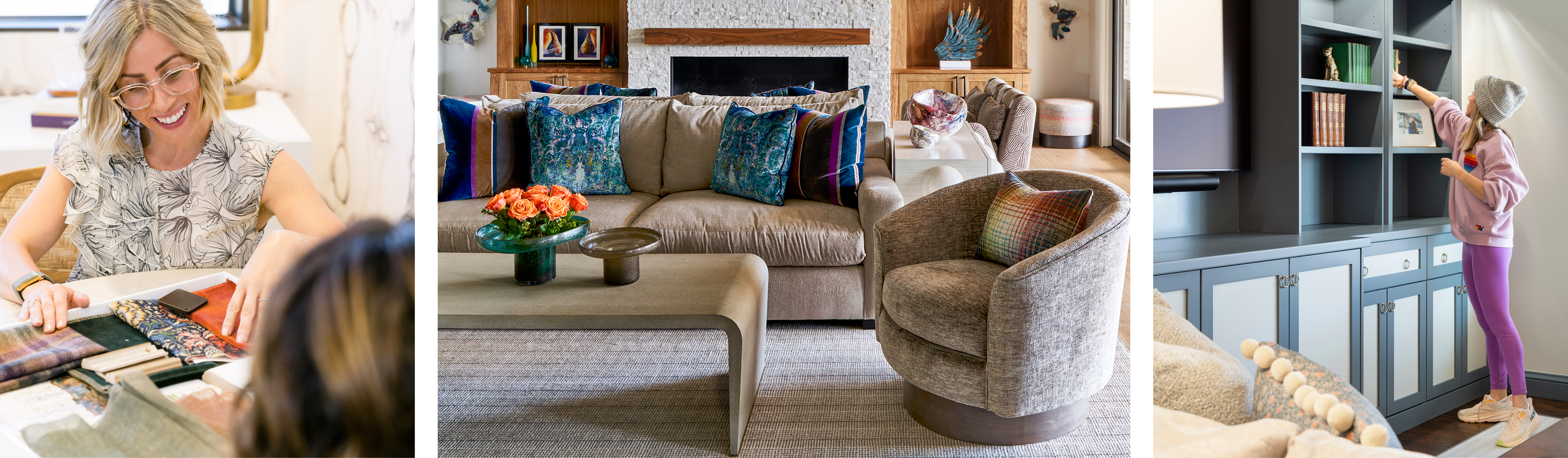
The first thing most clients say after a Duet Edit session is that the room looks bigger. Not because anything structural changed. Furniture got repositioned, competing accessories were removed, and the eye now has a clear place to land.
That shift, from a room that has things in it to a room that has a point of view, is usually what professional home styling results actually look like. It isn’t about adding more. It’s about creating coherence from what’s already there.
The Comment We Hear Most
The phrase that comes up most often after a first session is some variation of: “I can’t believe that was in here the whole time.” A lamp moved from a corner to a side table. A piece of art relocated from a hallway to the living room, where it finally has the wall it deserves. A throw blanket folded differently so the texture reads instead of disappearing.
None of these are dramatic interventions. They’re the kind of decisions that are obvious in retrospect and invisible without a trained eye catching them in the first place.
What Clients Are Surprised By
Two things come up consistently as surprises.
The first is how much the edit changes the feeling of a room, not just the look. Light reads differently. The room feels calmer, warmer, more intentional. Clients who were vaguely dissatisfied with a space without being able to name why often leave a session knowing exactly what had been off, and watching it get corrected.
The second surprise is what didn’t get touched. A good edit leaves most of a room alone. The pieces clients love, the things that carry memory or meaning, stay exactly where they are. The work is additive only when something is genuinely missing, and subtractive everywhere else.
What Does a Home Styling Service Do, Exactly?
It’s a reasonable question before booking, and it’s worth being precise. What does a home styling service do that the homeowner couldn’t do themselves with a free Saturday afternoon?
The answer is less about effort and more about perspective. A homeowner standing in their own living room sees the room they’ve always seen. The Duet Edit team walks in and sees it fresh. Which pieces are working and which ones are canceling each other out, where the eye gets stuck, which corner has been quietly ignored for years.
The Specific Work of a Session
What actually happens during a Duet Edit session:
- A room-by-room assessment of what’s working, what isn’t, and what the space needs to feel more resolved
- Repositioning of existing furniture, art, and accessories based on proportion, sightlines, and how light moves through the room
- Recommendations for what to add, remove, or swap, always grounded in the client’s existing palette and aesthetic rather than a new direction
- Sourcing for any additions, with installation handled by the Duet team, if the client wants it
The process isn’t prescriptive. It starts with listening: understanding how the client actually uses the room, which pieces carry meaning, and what the space is supposed to feel like. The styling follows from that conversation, not from a template.
The Time Factor for Busy Clients
For clients running demanding professional lives, the value of The Duet Edit is partly in the result and partly in the efficiency. An afternoon session produces changes that hours of DIY rearranging rarely achieve, because the team is working from accumulated expertise rather than trial and error. Clients don’t have to be home for the whole thing. Many come back to a finished room.
A significant number of Duet Edit clients move on to more involved work with Duet Design. Not because anyone pushed them to, but because the session gave them a first clear sense of what a professional design relationship feels like: structured, specific, and focused entirely on their home. Our post on why you shouldn’t DIY home decorating and design projects explores the gap between good taste and good execution, and why the latter almost always requires a professional.
What Clients Say About the Art Placement
One aspect of a Duet Edit session that consistently generates the most visible reaction is art. Art placement is one of the most common sources of quiet dissatisfaction in a well-furnished home. Pieces that are hung too high, grouped without intention, or simply in the wrong room entirely.
The Duet Edit team approaches art the way Devon’s interior design team approaches an entire project: with specific attention to scale, height, light, and what the piece needs around it to read correctly. A painting that looked unremarkable over a console can become the focal point of a room when it’s placed on the right wall at the right height with the right space around it. Our full guide to art selection goes deeper on how Duet thinks about art as a design element rather than a finishing touch.
The Difference Between Decorating and Editing
One of the phrases that comes up in almost every post-session conversation is some version of: “I thought you were going to add things.” The reality is that The Duet Edit removes as often as it adds, and sometimes more.
A room that has been decorated over time, where pieces have accumulated without a cohesive editing hand, often has too much in it. Not too much for the space, necessarily, but too much for the room to read clearly. When a decorative object competes for attention with five others on the same surface, none of them registers. The edit creates hierarchy: this is the object that leads, these are the ones that support, and this one is moving to storage because it’s fighting the story the room is trying to tell.
For clients who have already made significant investments in their home, furnishings, art, finishes, this kind of editing is often the most valuable service they can engage. They don’t need new things. They need someone to make the things they have work together the way they should.
Research on environmental psychology and home design points to visual clarity, specifically the absence of competing focal points and the presence of coherent composition, as one of the key factors in how people experience their own spaces. This is consistent with how design professionals across the industry think about styling work.
What Repeat Sessions Look Like
Most Duet Edit clients book a second session. Some turn the service into a recurring engagement, scheduling a refresh twice a year, once heading into spring and once in the fall, to keep the home feeling current without the disruption of a redesign.
Repeat sessions look different from the first one. The team already knows the home. They know which pieces the client is attached to, what’s been added since last time, and what the space needs at this point in the season. The work goes faster and the results tend to compound. A room that was edited once and then edited again six months later feels progressively more resolved.
What Changes Over Time
The subtlest professional home styling results are often the ones that take a year to fully appreciate. Luxe Interiors + Design’s 2026 color trend roundup reflects the same philosophy Duet brings to every edit: that the most considered spaces are defined as much by restraint as by addition.
A home that has been edited consistently, with the same point of view applied each time, starts to feel like it was always this considered. Guests comment on it without being able to explain why. The client stops feeling that vague dissatisfaction. The home simply feels right.
This is where The Duet Edit connects to the broader Duet philosophy: that a home isn’t finished on move-in day. It’s an ongoing relationship between people and their space, and it benefits from the same kind of intentional attention that produced the original design. Our post on interior design fundamentals reflects this idea: that the best homes are ones that keep getting better.
When The Duet Edit Connects to a Larger Engagement
The Duet Edit occupies a specific position within the broader Duet ecosystem. For clients who have completed a full interior design project with Duet Design, it is the service that maintains the integrity of that original work as the home evolves over time. New art acquisitions need to be placed. A room that worked well three years ago needs adjusting now that how the household uses it has changed. The seasonal rhythm of a well-maintained home requires consistent attention.
For clients who haven’t worked with Duet Design yet, a Duet Edit session is often the first introduction to how the team thinks. The experience of watching a trained eye move through a room and make specific, grounded decisions about what should stay, what should move, and what the room actually needs tends to answer the question of what working with a design professional really looks like.
Some clients find that this first session clarifies what they want from a longer engagement with Duet Design. Others find that the Duet Edit, on its own, is exactly what their home needs. Both are the right answer.
How the Duet Edit Fits Within the Larger Duet Ecosystem
The Duet Edit is one of four service disciplines within the Duet group, alongside Duet Design, Duet Forma, and Duet Build. For clients who engage more than one discipline, the Duet Edit team’s knowledge of the home connects directly to the broader design and construction work that preceded it.
This is most visible in how repeat Duet Edit sessions run in homes that were originally designed by Duet Design. The styling team already knows the design intent behind every room, which pieces were selected for specific reasons, and which decisions reflected long-term thinking versus practical compromises. That knowledge changes how the edit is done. Recommendations carry context that a team meeting the home for the first time wouldn’t have.
A Few Things Worth Knowing Before You Book
A first Duet Edit session typically runs two to three hours for a main living area. Clients can be present or not, depending on their preference. Most of the decisions are made by the team, with client input on anything that touches their own taste preferences.
The service is available as a standalone engagement or as part of a seasonal refresh package. It can also be added on after a completed Duet Design or Duet Build project, which many clients do to maintain the integrity of the original work as the home evolves over time.
If you want to see what a session could look like for your space, explore our home furnishings and styling service page for more on how the Duet Edit works in practice, or reach out directly and we’ll start the conversation.