Before Duet Design begins a project, there is a conversation that isn’t really about design at all.
It is about how you live. What matters to you in a home. What hasn’t worked before. What you are hoping a professional partnership can do that you couldn’t do on your own. It is also about whether Duet is genuinely the right firm for your project, and that is a two-way assessment, not just an intake form.
The interior design consultation process at Duet is structured around one central belief: a project that starts with the right questions produces a fundamentally better outcome than one that starts with assumptions.
Why the Questions Matter Before Anything Gets Designed
There are interior design firms that move quickly. You describe your style preferences, they show you some options, you pick things you like. The process is efficient and the results are often fine.
Duet doesn’t operate that way. Devon Tobin founded the studio in 2011 on a specific conviction: that a home can’t be designed well without understanding the people who will live in it. That conviction hasn’t changed. The questions that open a Duet engagement are the same questions that shape the design six months later.
What Duet Is Actually Trying to Understand
The early questions in a Duet consultation aren’t about aesthetic preferences. They come before that.
A few examples:
- How does your household actually use the home: which rooms get used daily, which ones are for specific occasions, which ones have never worked the way you hoped
- What does the home need to support that it currently doesn’t, whether that’s multigenerational family visits, a serious work-from-home practice, or entertaining at a scale the current layout can’t handle
- What design decisions have you made in the past that you would make differently now
- What is the one thing about your current home that you would least like to replicate
This last question often produces the most useful answers. People can struggle to articulate what they want; they are often very clear about what they don’t want anymore.
How Interior Designers Qualify Clients, and Why the Term Doesn't Capture It
The phrase “how interior designers qualify clients” implies a one-sided process where the firm decides whether you make the cut. Duet’s approach is closer to the opposite. The early conversation is designed as much to help the client understand whether Duet is right for them as to help Duet understand whether the project is right for Duet.
What This Looks Like in Practice
Devon’s team is transparent about what the Duet process involves. It is structured, multi-phase, and detailed. It asks a significant amount of the client in terms of time, engagement, and decision-making. Clients who want minimal involvement, who prefer to approve things from a distance and see the finished result, can work well with Duet, but they need to understand they will still be asked to engage at key decision points. No firm can fully substitute for the client’s own preferences, and Duet doesn’t pretend otherwise.
The early consultation is also where budget is discussed directly. Not in terms of whether the client can afford Duet’s services, but in terms of whether the client’s investment expectations are calibrated to what their project actually requires. Clients planning a large-scale renovation who have set an internal budget that can’t deliver the scope they’re describing will learn that in the first conversation, not six months in. Our post on how much an interior designer costs covers how to think about investment at the outset of a project.
The Questions Duet Asks About the Space Itself
After the lifestyle and expectation conversation comes a more specific set of questions about the physical environment.
Understanding What You're Starting With
Whether the project involves a new build, a renovation, or a fully furnished home that needs to be reconsidered, Duet needs to understand the architecture before any design thinking begins.
A few of the questions that shape this:
- What does the existing architecture do well, and what works against how you want to live
- Are there structural constraints or features that are fixed: load-bearing walls, existing window placements, ceiling heights
- What existing furnishings or pieces have personal significance, and which are open for reconsideration
- Is there a relationship between indoor and outdoor space that needs to be addressed
For clients undertaking a renovation alongside interior design, this is also where the conversation about Duet Build comes in, whether construction management should be part of the engagement, or whether the client already has a builder relationship in place.
Understanding the Design Brief
The design brief that emerges from an early Duet consultation isn’t a style description. It is closer to a set of performance requirements for the home: what it needs to do, how it needs to feel, what it needs to support, and where the existing space falls short of those requirements.
This brief then travels through the entire design process. Material selections, furniture choices, lighting decisions, all of them are evaluated against it. It is the document that prevents the slow drift that can happen in long projects, where the design gradually migrates away from the client’s original vision without anyone noticing until the installation is complete.
What Happens When the Fit Isn't There
Duet doesn’t take every project that inquires. This isn’t exclusivity for its own sake. It is a practical acknowledgment that some projects and some client relationships aren’t set up for the kind of collaboration Duet’s process requires.
The Signs That Usually Surface Early
A few signals that typically come out in the early consultation:
- A timeline that isn’t realistic for the scope described: when a client wants a full-home redesign completed in eight weeks, the honest answer is that Duet can’t deliver that well, and saying so early protects everyone
- A design vision that is fully formed and not open to any professional input: Duet’s process is collaborative, and it doesn’t work well when the designer’s role is reduced to executing a predetermined brief
- A budget that doesn’t align with the project scope after an honest conversation about what the work requires
When these signals are present, Devon’s team says so directly. It is a more useful conversation than proceeding with a project that isn’t set up to succeed. This kind of honest early dialogue is consistent with NAHB guidance on the builder-client relationship, which applies equally to design engagements: the right fit matters as much as the firm’s credentials.
What Clients Who Are the Right Fit Look Like
The Duet clients who get the most from the process tend to share a few characteristics that have nothing to do with their budget or the size of their home.
They have a clear sense of what they want the home to feel like, even if they can’t always describe it in design vocabulary. They are prepared to engage seriously at key decision points, even if they trust Duet to carry the day-to-day process. They understand that a considered design takes time, and they’re not trying to rush past the stages that make the result worth having.
For clients building a home meant to serve a family across decades, to host grandchildren and gatherings and the accumulated life of a household, this kind of design relationship is worth more than the individual project it produces. The right design partner understands the home as a long-term investment in how a family lives, not a transaction. Our post on full-service interior designers explains what this level of engagement actually involves for the client.
What the Discovery and Style Identification Phase Actually Involves
After the early consultation confirms a good fit, the project moves into the discovery phase, the part of the interior design consultation process that clients often find most surprising and most useful.
Why It's a Multi-Step Process, Not a Single Meeting
Most clients can describe their style in broad terms when asked directly. Modern but warm. Traditional but not stuffy. Colorado mountain but not rustic. These descriptions are a starting point, not a design brief. They tell the designer the general neighborhood; they don’t give them the street address.
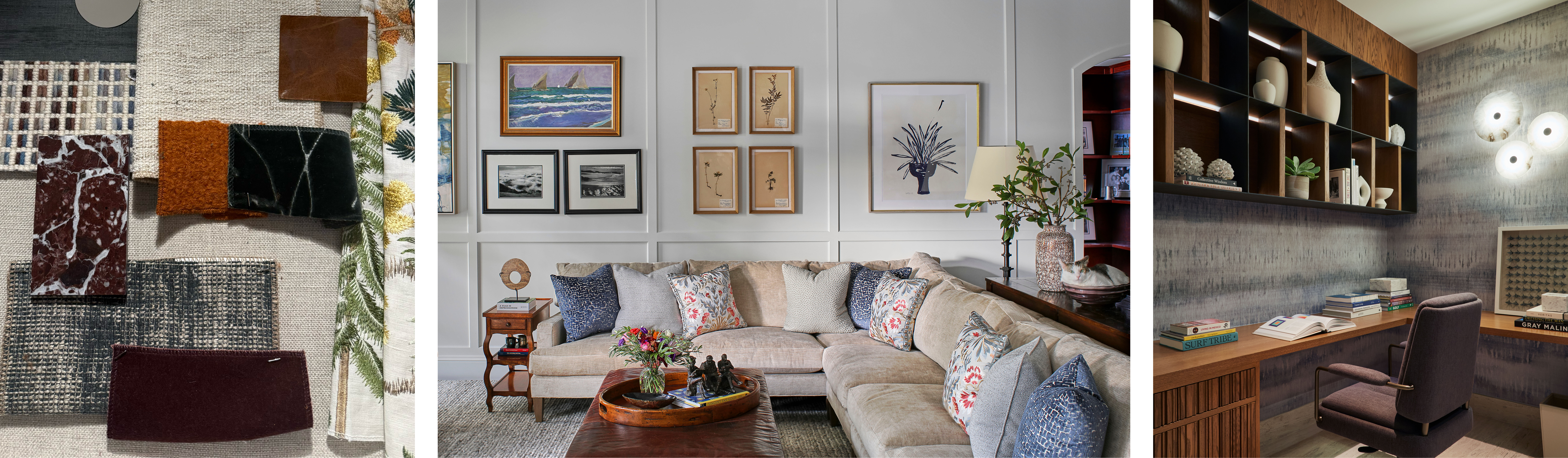
The Duet discovery process is designed to get past the general description to the specific instincts underneath it. Clients respond to images, to materials, to spaces, and those responses reveal patterns that no amount of verbal description could surface as clearly. A client who says “modern” consistently gravitates toward images with warm wood tones and soft textiles. That client’s home is going to look very different from a client who says “modern” and consistently gravitates toward pale stone and minimal ornamentation. The discovery process finds the difference.
What Clients Walk Away With
By the end of the discovery phase, both the client and the design team have a shared visual language for the project. Decisions made throughout the engagement can be evaluated against it. When a material or a finish is proposed, everyone in the room has a common reference point. This prevents the drift that happens in long projects when individual decisions accumulate without a consistent through-line connecting them.
The American Society of Interior Designers emphasizes this kind of structured client discovery as a core professional standard, the foundation on which a genuinely personalized design is built, rather than one that reflects the designer’s preferences or the season’s available inventory.
Houzz’s research on client satisfaction in design projects consistently identifies the quality of early intake and discovery as one of the strongest drivers of overall client satisfaction, more than the designer’s portfolio or aesthetic.
After the Early Consultation
When the early conversation confirms that the fit is right, the project moves into the discovery and style identification phase: the structured, multi-step process that has been central to Duet’s approach since Devon founded the studio. This is where the design brief developed in the consultation gets translated into a specific, visual direction.
For clients who are still considering whether the timing is right for a full engagement, Duet Edit is sometimes the right starting point: a lower-commitment way to experience how the team works, applied to a single room or a seasonal refresh. Our post on 11 simple interior design ideas and tips offers a sense of the design philosophy that carries through every Duet engagement, from a full-home project to a one-session styling visit.
The best place to start is a conversation. Learn more about Duet Design’s residential interior design services or contact our team directly to talk through your project and where it stands.